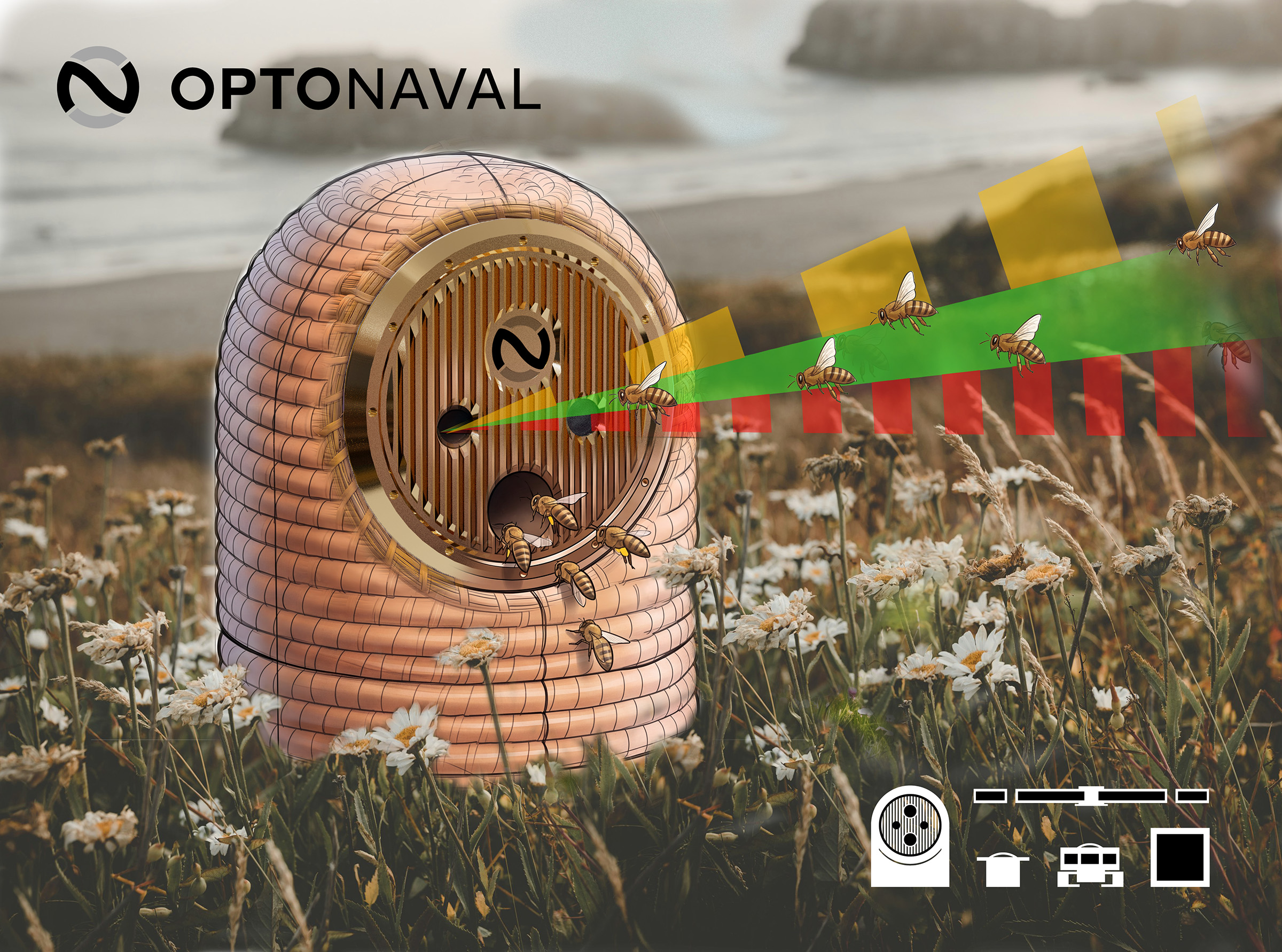
OPTONAVAL Honey
Our Buzzing Employees: Honey Bees at OPTONAVAL
When you visit OPTONAVAL, you will discover more than advanced maritime technology and helicopter landing systems. Our premises in Hamburg-Wilhelmsburg are also home to some rather special residents: our very own honey bees.
For the past three years, we have been hosting several bee colonies on our premises, professionally cared for by a local beekeeping partner. The hives remain on site throughout the year, providing a permanent home for thousands of industrious little neighbours.
From here, the bees set out on their daily flights, collecting nectar and pollen from the surrounding area before returning home to their hives.
Teamwork Makes the Difference
A honey bee colony is a fascinating example of teamwork. During the summer months, a single colony can contain up to 50,000 bees, each contributing to the success of the entire community. Some collect nectar and pollen, others care for the brood, maintain the hive or protect the colony. Every bee has a role to play, and every contribution matters.
In a way, this is something we can relate to at OPTONAVAL. Our engineers, production specialists, project managers and commercial teams all bring different skills and expertise to the table. It is their combined effort that allows us to develop, manufacture and deliver reliable maritime lighting and helicopter landing systems to customers around the world.
Fun fact: Did you know that a single worker bee produces the equivalent of only about 0.5 grams of honey in her entire lifetime? That means a 500-gram jar represents the collective lifetime contribution of roughly 1,000 bees. A remarkable reminder of what can be achieved through teamwork!
But the bees' contribution goes far beyond producing honey. While collecting food, they also pollinate flowering plants, supporting plant reproduction and the surrounding ecosystem.
From Wildflowers to Lime Trees
Although OPTONAVAL is located in an industrial area of Hamburg, our surroundings offer a surprising amount of greenery. Between commercial properties, along railway embankments and across nearby green spaces, wildflowers, naturally occurring vegetation and trees provide valuable sources of nectar and pollen. Lime trees, in particular, can be an important source of nectar during the summer months. As the seasons change, so does the bees' menu. Different plants bloom throughout spring and summer, and our bees follow the available food sources across the surrounding landscape.
One of their most impressive abilities is their sense of orientation.
While helicopter pilots rely on visual references and precisely designed lighting systems for safe approaches and landings, bees navigate using an entirely different set of tools. They use the position of the sun, visual landmarks and their remarkable ability to recognise their surroundings to find their way back to the hive.
For a company specialising in helicopter visual landing aid systems, we find that particularly fascinating.
After all, safe navigation and finding your way home are things we know a little about at OPTONAVAL.
From Nectar to ON Honey
Producing honey is a complex process that requires patience, coordination and a great deal of work. The bees collect nectar from flowers and bring it back to the hive, where it is passed between worker bees, enriched with enzymes and stored in honeycomb cells. By reducing the water content, the colony gradually transforms the nectar into honey. Once it has reached the right consistency, the bees seal the cells with a thin layer of beeswax.
When the time is right, our beekeeping partner carefully harvests the surplus honey, extracts it from the combs and prepares it for bottling. The result is something we are particularly proud of: our very own ON Honey, produced by the bees living right here at our Hamburg premises. Every jar is a small reflection of our local surroundings, the changing seasons and the extraordinary work of our smallest colleagues.
A Little Piece of OPTONAVAL to Take Home
For us, ON Honey is not a commercial product. It is something we enjoy sharing with our customers, partners and friends. 2026 marks the third year of our bee project, and this year's fresh honey harvest has now been completed. What started as a small initiative has become a tradition that we are happy to continue.
Perhaps one of our jars has already found its way onto your breakfast table. If so, you now know a little more about where it comes from and the thousands of tiny contributors behind it. And if you haven't received a jar yet, perhaps there will be an opportunity on your next visit. In the meantime, our bees will continue doing what they do best: working together, exploring their surroundings and always finding their way home.
From our hives in Hamburg to your breakfast table – a little taste of OPTONAVAL.